
Cities are entering a new phase of waste management.
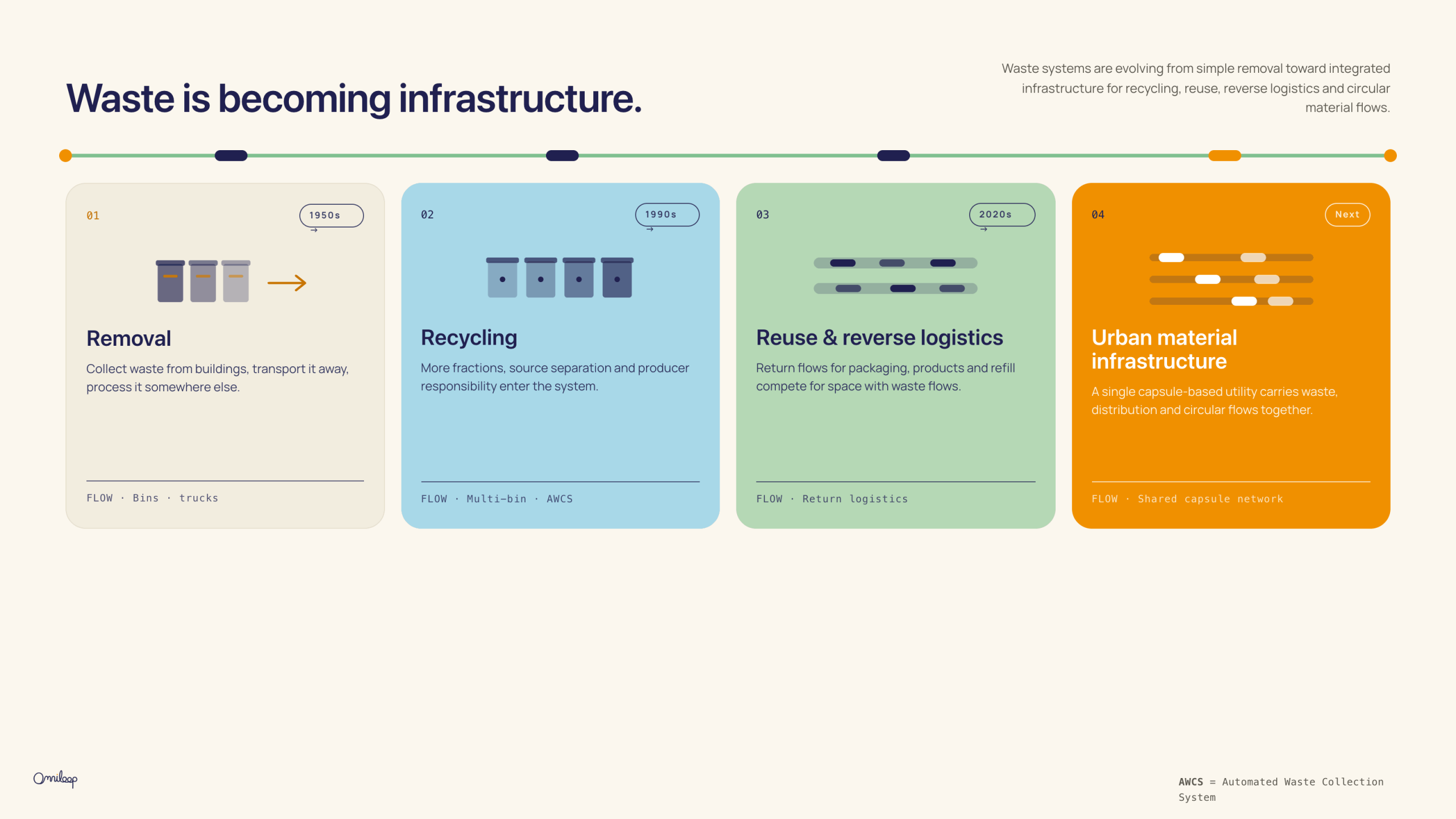
For decades, waste collection was mainly treated as a removal problem: collect waste from buildings, transport it away, and process it somewhere else. That logic worked reasonably well when the system handled a limited number of waste streams and when urban space was less constrained.
But this is no longer the reality.
New requirements for source separation, material recovery, producer responsibility and traceability are changing what waste systems must be able to do. At the same time, cities are becoming denser, streets are more contested, and every square metre in and around buildings has become more valuable.
The result is a simple but important shift:
Waste collection is no longer just an operational service. It is becoming long-life urban infrastructure.
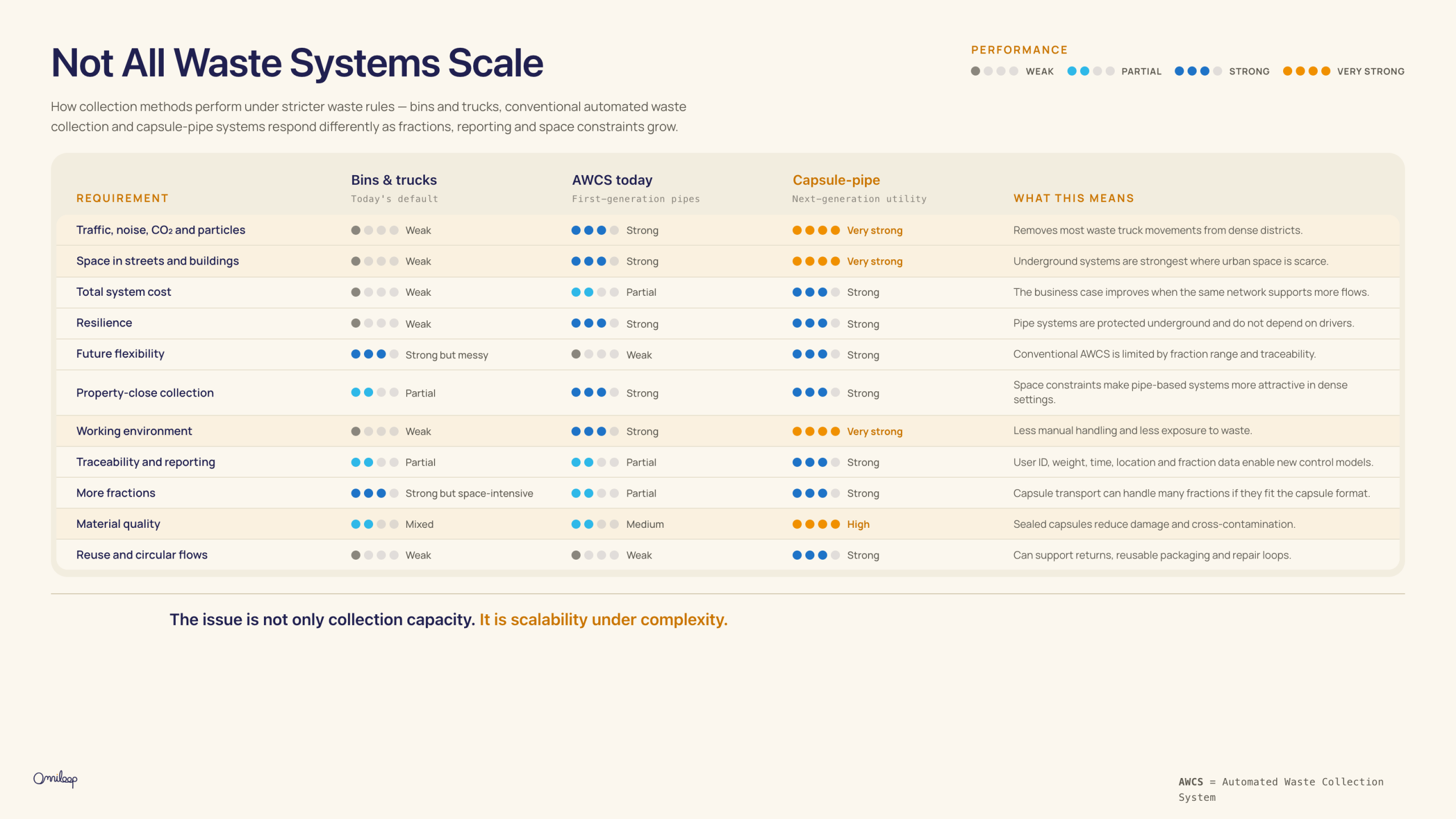
This matters because different collection systems do not scale equally when requirements increase.
More fractions change the problem
Sweden is a concrete example of this shift.
Households already need nearby collection for food waste and residual waste. From 2027, municipalities must also provide property-close collection for household packaging fractions such as paper, plastic, metal, coloured glass and clear glass.
That means more fractions closer to where people live.
For property owners, this creates pressure on space inside buildings and on courtyards. For cities, it creates pressure on kerbs, streets and public space. For waste operators, it creates more collection points, more handling and more operational complexity. For residents, it risks making sorting less convenient if the system becomes physically crowded and difficult to understand.
The challenge is not only to collect more fractions
The real challenge is to collect them in a way that preserves material quality, reduces surface logistics, supports traceability and remains adaptable as future requirements evolve.
Bins and trucks are flexible, but they scale poorly
Bins and trucks remain important. They are familiar, flexible and can handle many fractions. In lower-density areas, they will continue to be a practical backbone of waste collection.
But in dense urban environments, each additional fraction tends to add physical complexity: more bins, more space, more collection events, more access requirements and more traffic conflicts.
This is why the future problem is not only about adding capacity. It is about avoiding a system where every new requirement creates another surface-level burden.
Bins and trucks are flexible, but that flexibility comes at a cost.
Conventional AWCS solved one problem — but not the next one
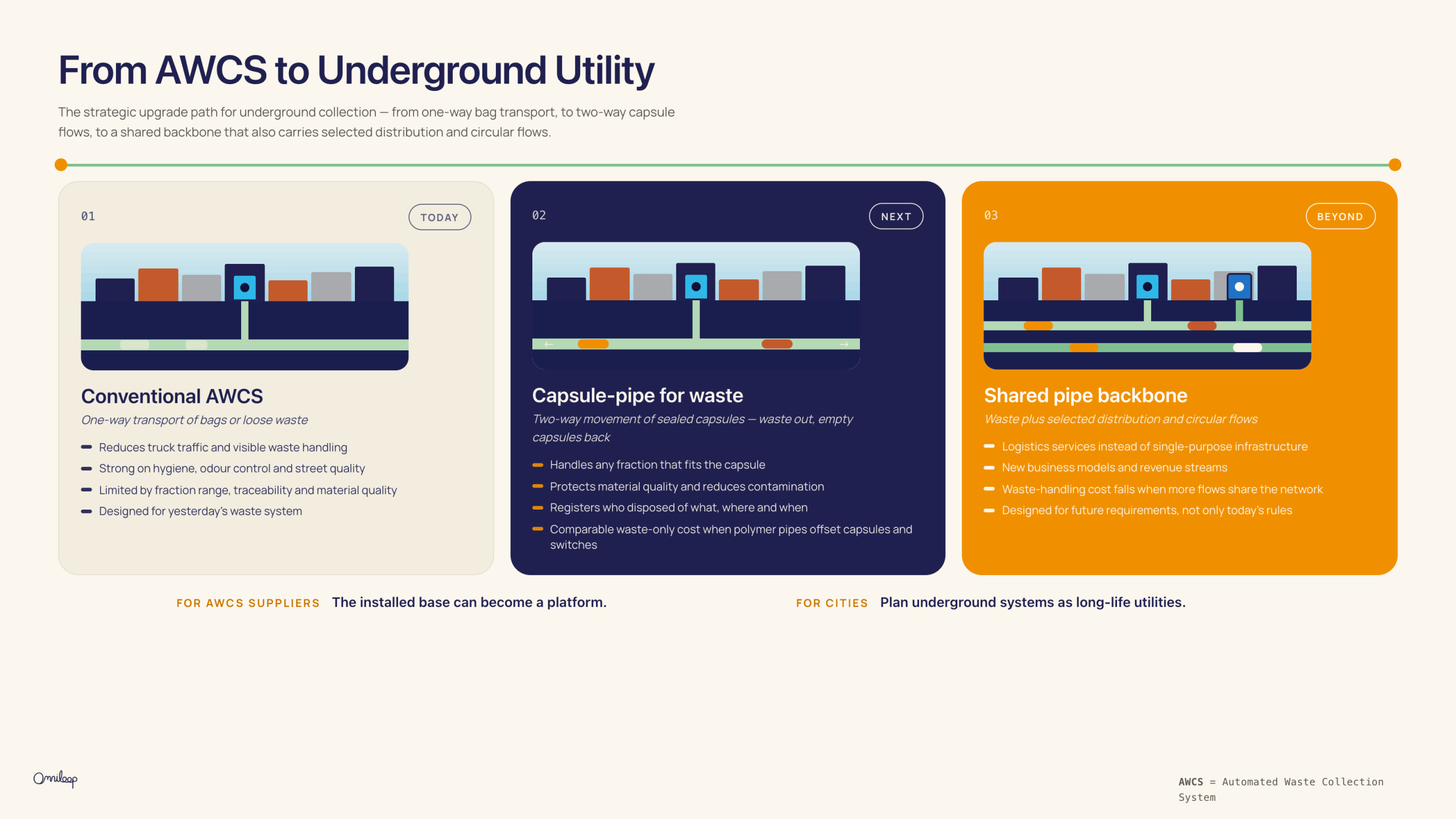
Automated Waste Collection Systems, or AWCS, have already improved parts of urban waste management. By moving waste through underground pipes to terminals, they reduce truck movements inside residential areas and improve hygiene, odour control and local street quality.
This is valuable.
But conventional AWCS was designed for a different waste world. It typically works with a limited number of fractions and is based on one-way transport of bags or loose material. That makes it difficult to scale when the future requires more fractions, better material quality, higher traceability and more adaptable flows.
In other words, conventional AWCS is not obsolete. But it is incomplete.
The next question is whether the installed base and the underlying logic can evolve.
Capsule-based systems will change the transport principle
A capsule-based system changes the basic architecture.
Instead of transporting loose or bagged material directly through the pipe, the material is first placed inside a sealed reusable capsule. The capsule is then transported through the pipeline network to the right terminal or sorting point.
This has several consequences.
First, the material is protected during transport. Glass, metal, paper, textiles and other sensitive fractions are less exposed to damage or contamination from other waste streams.
Second, many fractions can use the same inlet and the same pipe infrastructure, as long as the material fits inside the capsule.
Third, each disposal event can be recorded: user, location, fraction, weight and time. This makes traceability, reporting, feedback and incentive models much more realistic.
Fourth, the same infrastructure can be designed for two-way flows: full capsules out, empty capsules back — and later, potentially, other circular flows.
That is why capsule-based waste collection should not be seen only as “better waste transport”. It is a candidate for a broader infrastructure layer for urban material flows.
The real value is upstream
A common mistake in recycling policy is to focus too much on downstream sorting.
Of course sorting technology matters. But material quality is often won or lost much earlier. If fractions are mixed, contaminated, damaged or exposed during collection and transport, downstream sorting can only recover part of the lost value.
A more capable collection infrastructure helps preserve value before it is destroyed.
For waste operators and material users, this is critical. Better upstream separation and protected transport can improve the quality and value of collected material. For producer responsibility organisations, it can improve reporting and control. For municipalities, it can support both compliance and better system design.
This is also where capsule-based systems become interesting from a research and development perspective. The technology raises questions that are highly relevant to municipalities but not yet sufficiently answered:
- Which fractions can be handled safely and efficiently in capsules?
- How much space can be saved in buildings and streets?
- What level of traceability is feasible and useful?
- What are the cost effects compared with bins, underground containers and conventional AWCS?
- Which legal and organisational barriers must be solved?
- What should a demonstrator or test facility actually test?
These are not product-sales questions. They are sector-learning questions.
Why this deserves a shared reference frame
Before cities can decide whether capsule-based waste collection is a realistic option, the sector needs a common reference frame.
Today, knowledge about bins, trucks and conventional AWCS is relatively well established. Knowledge about capsule-based systems for municipal waste and circular flows is still limited. That creates uncertainty for municipalities, property owners, operators, regulators and suppliers.
This is exactly why a pre-study is valuable.
A good pre-study should not assume that capsule-based systems are the answer everywhere. Instead, it should clarify where the approach may be relevant, what problems it can solve, what barriers exist, what requirements must be met and what a demonstrator needs to prove.
The most important outcome is not a promise.
The most important outcome is better decision-making.
Conclusion: waste collection is becoming infrastructure
The next generation of waste collection will not be defined only by how waste leaves a building.
It will be defined by how well the system handles increasing complexity: more fractions, better material quality, traceability, limited urban space, circular flows and long-term adaptability.
Bins and trucks will remain part of the system. Conventional AWCS will remain useful in many places. But capsule-based systems deserve serious attention because they change the underlying logic.
They move the discussion from “How do we collect more waste fractions?” to a more strategic question:
How do we build urban material infrastructure that can handle future flows at scale?
That is the real transition. Waste collection is becoming a utility for the circular city.
What if the biggest waste collection problem is not sorting?
What if it is the system we use before sorting even begins?
Cities are now expected to collect more fractions, closer to buildings, with higher material quality, better reporting and less impact on streets.
The usual answer is more bins.
More rooms to keep the bins in.
More collection points that need to be serviced.
More truck movements that generate traffic, CO2 and congestion.
This does not scale well in dense urban areas.
Conventional automated waste collection solved part of the problem by moving waste underground. But today’s systems were mainly designed for a limited number of fractions and one-way transport of bags.
The next step may be different:
- Sealed capsules.
- One simple user interface.
- Protected material flows.
- Traceability per disposal event.
- Two-way underground transport.
- And, eventually, infrastructure that can also support circular flows and reverse logistics.
This is why waste collection should no longer be treated as just an operational service.
It is becoming urban material infrastructure.
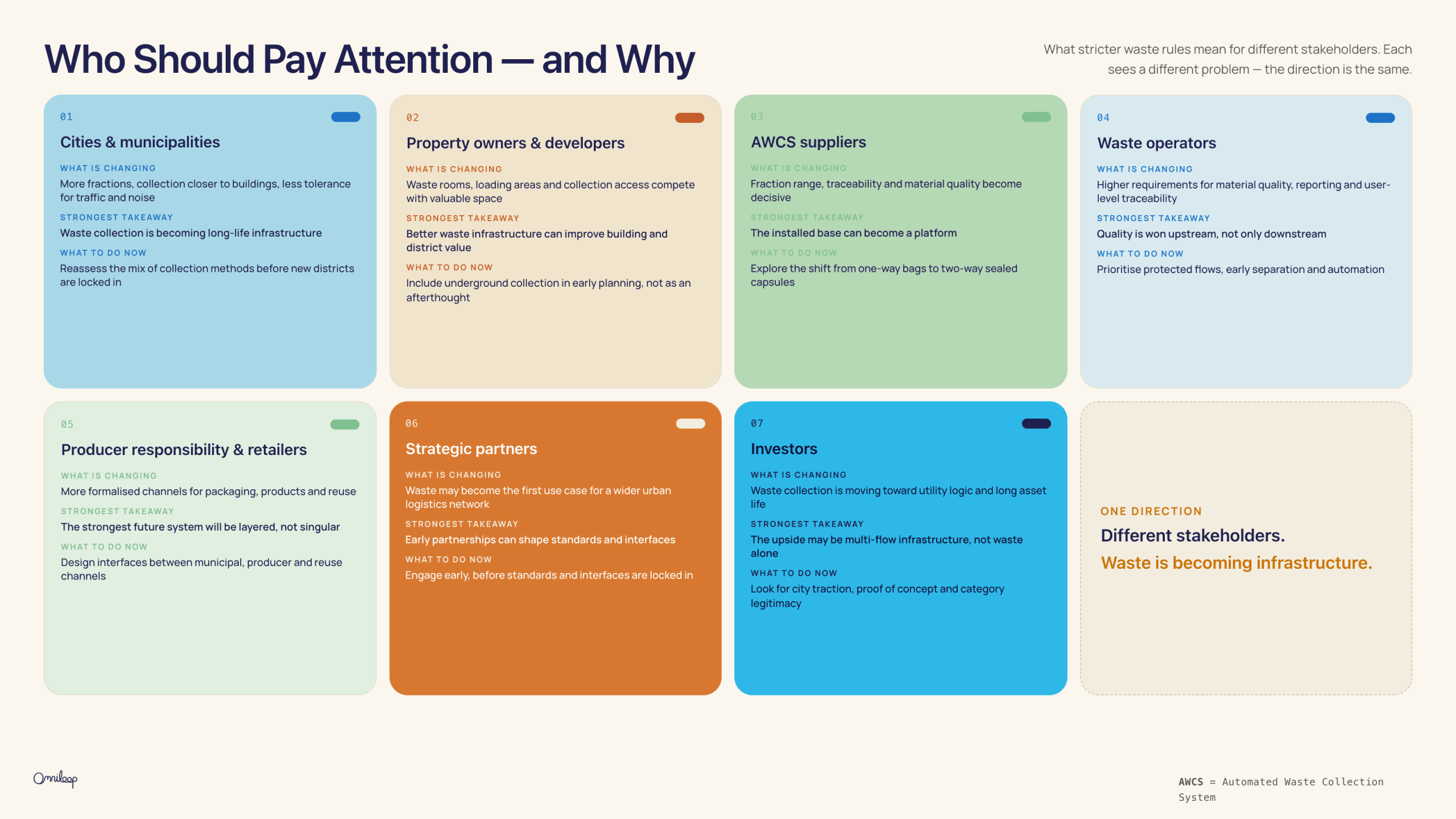
For cities, property owners, waste operators, AWCS suppliers, producer responsibility organisations and investors, this changes the question:
Not “Which collection method is cheapest today?”
But:
Which system can still perform when requirements, fractions and circular flows keep increasing?
Waste is not only a material problem.
It is an infrastructure problem.
The text above is an illustration of how capsule based transport brings value to cities and how it is becoming infrastructure. And we are not alone! Together with these pioneers we are moving the world forward, towards a better and more future-proof infrastructure in cities:
Moving parcels: Pipedream Labs, Tubular Network, CargoFish