
A framework for investing in collection and transport systems for waste
From 1 January 2027, Sweden’s household waste collection system will change in practice. It is no longer enough to arrange for the collection of food and residual waste near households. It will also be mandatory to arrange the collection of used packaging at the property, including paper/cardboard, plastic, metal, colored glass, and clear glass [1]. This is urgent because it turns a compliance question into a strategic infrastructure question.
All other waste fractions will continue to be collected at local recycling stations (återvinningsstationer) or the manned recycling centres (återvinningscentraler). All plastic bottles and aluminium cans with a Swedish pledge (pant) mark must be pledged in a pledge machine in most grocery stores, where the deposit is refunded.
How do we build a logistics system that moves clean material from households to recyclers with less space requirements, fewer trucks, lower contamination, and better data?
This article presents a first version of a framework for analysing investments in the infrastructure for the collection and transportation of waste. It is a hypothesis-driven starting point that should be refined with empirical data and verified in real investment analyses. Waste collection is becoming the logistics infrastructure for the future of material circulation.
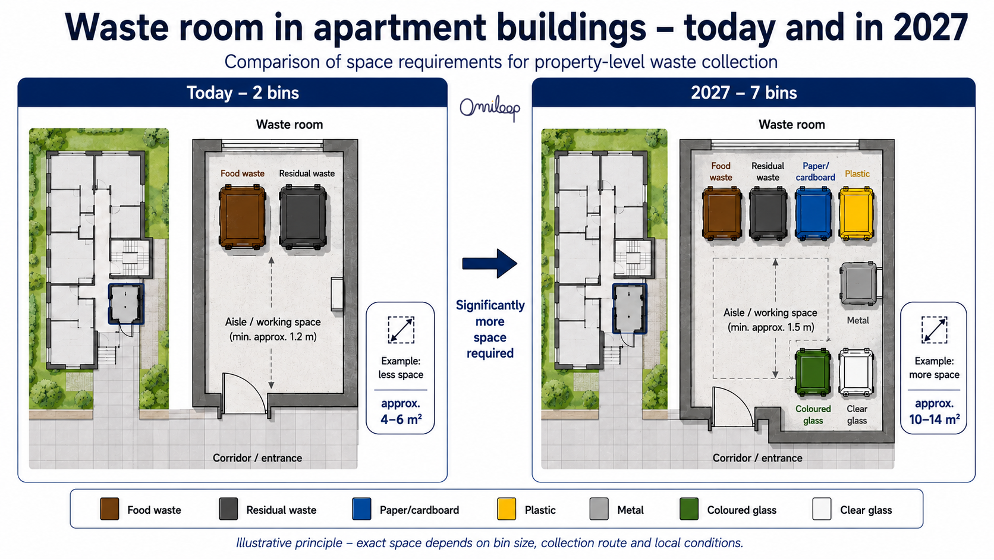
From waste removal to material logistics
A future-ready collection system must be easy for households to use, fit into space-constrained properties, reduce unnecessary truck movements in residential areas, keep fractions clean, and remain flexible enough for future flows such as newspapers/magazines, textiles, small electronics, batteries, reuse streams of products and packaging, and digital product information to be used by AI.
We should therefore compare logistics chains, not only collection methods:
Household → property-level deposit point → collection → pipe or truck → sorting or transloading →pipe or truck → recycler or treatment actor
The collection system sits between upstream product design and downstream recycling. It can preserve material value, or destroy it through contamination, mixing, breakage, poor data and inefficient transport.
Three logistics chains to compare
1A. One bin per fraction
The most familiar solution is one bin or underground container per fraction. It is proven, robust, and easy to understand, but it is space-hungry, truck-intensive, and harder to scale as more fractions are added.
1B. One bin for all colour-coded bags – one per fraction
Households sort waste into colour-coded bags in their kitchens – one per fraction. The bags are placed in a single bin or container, which is emptied into a garbage truck and then taken to a bag-sorting facility. From there to the recycler. Save space at the property, but performance relies on the sorting process.
2A. Four vacuum collection inlets plus two bins
Traditional automated vacuum collection can handle the high volume of food waste, residual waste, paper/cardboard, and plastic. Glass and metal typically still require separate bins or underground containers, with collection by truck. This reduces truck movements but creates two parallel logistics chains.
2B. One vacuum collection inlet for colour-coded bags plus two bins
Same as 2A, but households first sort into colour-coded bags. Four colours are placed in a single vacuum collection inlet, and three colours are thrown into bins or containers.
3A. One capsule-based vacuum collection inlet for all fractions
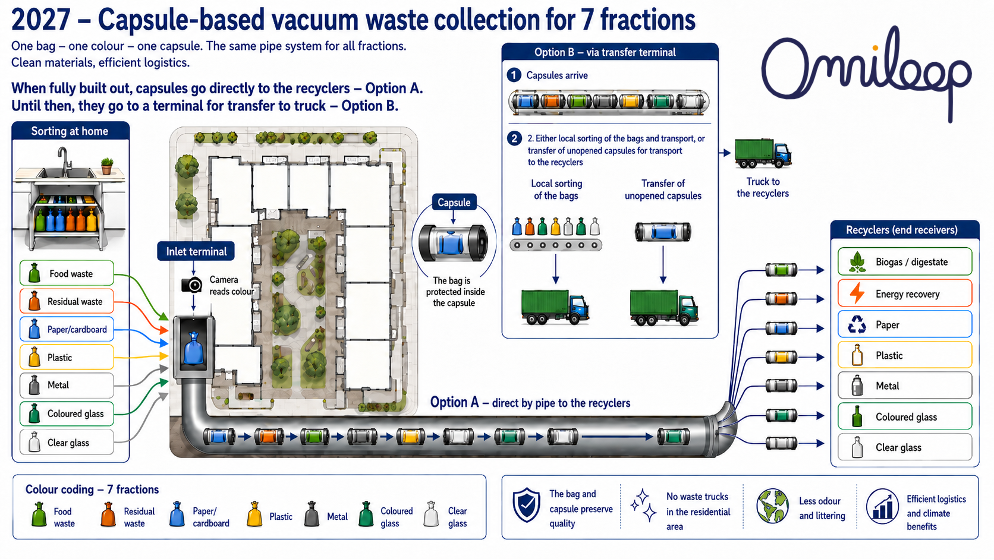
As 1A, where households throw one fraction of their waste into the inlet at a time. There it drops into a capsule, one per fraction. The capsule is sealed and transported through a pipe system. In a fully built-out pipe system, capsules are routed directly to the right recycler. During earlier deployment, capsules are routed via a transfer terminal and onward by truck to the right recycler.
The advantages are cleaner fractions, less contamination, fewer waste trucks in residential areas, the ability to handle many more fractions, better data, and a cost comparable to traditional automated vacuum collection. The limitations are a lack of technology maturity, uncertainty, and the need for demonstrators and operational evidence.
3B. One capsule-based vacuum collection inlet for all colour-coded bags
As 3A, but households first sort into colour-coded bags in their kitchens. At the inlet, one bag is placed into a capsule, sealed, and transported through a pipe system. In a fully built-out system, capsules are routed to the right recycler. If they are routed to a bag sorting facility, several smaller colour-coded bags can be disposed of in the same capsule. This reduces the space needed for bags in the kitchen and the number of capsules in circulation.
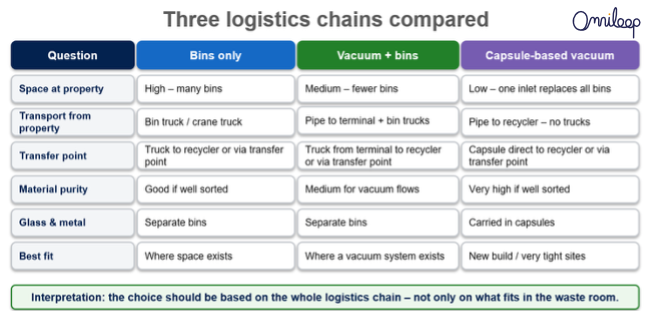
The figure above depicts the alternatives 1A, 2A and 3A. For the B alternatives, colour-coded bags are used and sorted at a sorting facility. These reduce the space requirements at the property for 1B and 2B, and the requirement of pipes all the way to the recyclers for alternative 3B.
Behaviour is part of the infrastructure
The best technical system will fail if households do not use it correctly. A good system should be easy to understand, close enough to use, clean, visually self-explanatory, and consistent from the kitchen to the deposit point. It should minimise smell, dirt, physical contact and uncertainty.
Dirty disposal environments can trigger disgust and avoidance responses, reducing compliance with waste rules [8]. This is not only a behavioural issue. It is a logistics issue: if people avoid touching lids, leave quickly or place bags incorrectly, the downstream material flow deteriorates before transport begins.
A clean and understandable deposit point is part of the material-quality system.
Data and AI: why the logistics chain matters
AI is only useful when the supply chain provides usable data. The data does not have to be complicated: what fraction class the material belongs to, where it entered the system, when it entered, who entered it, and whether it has been mixed, damaged, or contaminated. A product passport is a formal version of this idea, proposed by the EU for circular flows of used products; in waste logistics, a simpler material pedigree can follow a bag, capsule, bin, or container.
The choice of logistics chain determines how much data can be registered. A bin-per-fraction system primarily provides data at the bin, vehicle, and route levels. Colour-coded bags indicate the intended fraction that is later used at a sorting facility. Vacuum collection adds data from inlets, pipes and terminals. Capsule-based systems can, in principle, maintain bag or capsule identity throughout the chain, making it easier to route material, detect problems, and provide feedback.
With such data, AI can help predict fill levels, plan collection, detect contamination, schedule terminal capacity and compare future infrastructure choices before they are built. Without data about the material, AI can still optimise trucks and facilities, but the material itself remains a largely anonymous load.
What should an investment framework measure?
| KPI | What to assess |
| Compliance | Can the system meet current and expected requirements? |
| Space | How much waste-room, courtyard or street space is needed? |
| Transport | How many vehicles are required close to homes? |
| Material quality | How clean are the fractions when handed over to recycler? |
| Behavioural friction | Is it easy for households to do the right thing? |
| Digital traceability | Can data follow the bag, bin, capsule or fraction? |
| Material pedigree | Can identity, quality and chain-of-custody data be preserved? |
| Economics | What are the costs per household, per ton, and per correctly sorted kilogram? |
| Robustness | What happens during overfilling, disruption or misuse? |
The purpose is not to find one system that is always best. The purpose is to choose the right combination for the specific property, district or city, and situation.
From compliance to circular value
The 2027 requirement creates urgency. But the strategic opportunity is larger. The next generation of property-level collection should not only answer how all required fractions are collected. It should also answer how clean the material is when the recycler receives it, how many truck movements are created, how easy it is for households to do the right thing, whether future fractions can be added, and whether information can follow the material.
Waste collection is becoming the logistics infrastructure for the circulation of materials. The future system will not be judged only by how efficiently it removes waste from buildings. It will be judged by how well it preserves the value of the material as it returns to the economy, and by how much it reduces residual waste converted to energy or sent to landfill.
We are not alone! Together with these pioneers we are moving the world forward, towards a better and more future-proof infrastructure in cities:
Moving parcels: Pipedream Labs, Tubular Network, CargoFish
Mowing waste: Envac, Marimatic, Ecosir, Logiwaste
References
[1] Swedish packaging producer responsibility regulation and implementation of property-level collection for household packaging waste, including the 1 January 2027 transition.
[2] Naturvårdsverket. National Waste Plan 2024–2030: Waste in a Circular Society.
[3] Naturvårdsverket. Action List for the Waste Prevention Programme and National Waste Plan.
[4] European Commission. Packaging and Packaging Waste Regulation.
[5] European Commission. Waste Framework Directive and Circular Economy Action Plan.
[6] European Union. Ecodesign for Sustainable Products Regulation and digital product passports.
[7] Michie, S., van Stralen, M. M. & West, R. (2011). The behaviour change wheel. Implementation Science.
[8] Sohlberg, J. & Esaiasson, P. (2026). How Disgust Sensitivity Shapes Waste Disposal Behavior in Everyday Public Environments. Journal of Environmental Psychology, pre-proof.