
Underground logistics is the only viable long-term mode for cities
City planners and municipal governments are currently fighting a losing battle for street space. The modern urban goal is clear: reduce traffic and emissions, create “15-minute cities” with protected sidewalks and bike lanes, and vibrant public spaces. However, these goals are constantly undermined by the reality of modern logistics. Our streets are clogged with delivery vans and private cars circling for parking, heavy garbage trucks navigating narrow streets, and mopeds carrying warm food. About 30-50% of private car kilometres in cities are used to move goods rather than people. E.g., go to the supermarket, the shoe shop, the pickup location for things bought online, take-away food, or the waste and recycling site.
Citizens are increasingly realising that the street space could be used for things other than cars, and many cities are implementing car-free or at least climate zones. This trend gained further momentum during the lockdowns under the COVID-19 pandemic. The concept of the 15-minute city stresses the importance of arranging access to services and products within short walking or biking distance.
To improve sustainability, there is political pressure to increase the reuse and the life of packaging, products, components, and materiel. These circular flows require more transport than today’s linear flows.
2/3 of the emissions of climate gases occur in cities. Analyses have revealed that changing transport users’ behaviour and electrification alone will not be sufficient. Innovations and new technologies are needed to achieve the goal of the Paris Agreement and the EU’s Green Deal.
Each year, 3 million people die from air pollution, mainly from motor vehicle emissions in cities. Another 1.2 million die in road traffic accidents, and in cities, it is mostly unprotected road users. To this should be added that motor vehicle noise in cities causes significant health problems.
E-commerce is expected to increase its market share considerably across all types of goods, but the logistics systems to handle the last mile are very inefficient.
In the last decade, several innovations have been proposed and partially implemented to address these challenges, including cargo bikes, sidewalk robots, air drones, parcel lockers, electrification, and digitalisation.
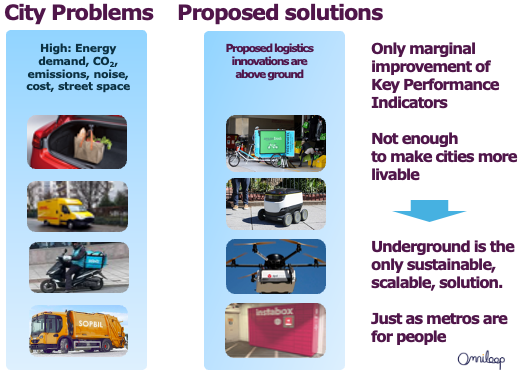
Proposed solutions are good, but they only improve the situation marginally
Sharing data and the use of all transport facilities as if they were owned by a single organisation – the Physical Internet Concept – is expected to improve all performance indicators, but there are serious barriers for competing companies to share data and the use of trucks and terminals.
Most pilots with urban consolidation and micro-hubs for load-pooling have not been successful, partly because customers demand fast delivery and because of the many difficulties of sharing data among competing companies.
Night docks, parcel lockers, and smart door locks make it easier to deliver even when the receiver is not present.
Electrification and smaller vehicles will reduce CO2 emissions, but high costs, congestion, and harmful particulate emissions persist.
Some driver costs can be eliminated by using sidewalk robots and air drones. However, none of those is expected to take a large market share. Sidewalk robots take up a lot of street space, and drones are weather-sensitive and energy-intensive.
But none of those fixes the core constraint of urban logistics: space.
The state-of-the-art studies on underground logistics, Fengshan et.al.2025, Viser, 2018 and Wanjie et.al. 2025, clearly show that many underground logistics concepts are both technically and economically feasible. They score high on the key performance parameters discussed above. Hence, underground logistics seems to be the only long-term, scalable, and viable solution, as metros were considered for passengers 170 years ago.
By moving logistics underground, cities can also make a massive leap toward “Vision Zero” safety goals. A capsule in a pipe cannot run a red light, block a crosswalk, or hit a cyclist.

Yet very little has been implemented to date. However, a few pioneers in this emerging industry are leading the way, besides Omniloop:
Moving parcels: Pipedream Labs, Tubular Network, CargoFish
Mowing waste: Envac, Marimatic, Ecosir, Logiwaste
References
Fengshan, Li , Kum Fai Yuen. A systematic review on underground logistics system: designs, impacts, and future directions. Tunnelling and Underground Space Technology 159 (2025) Elsevier
Visser, Johan. The development of underground freight transport: An overview. Tunnelling and Underground Space Technology 80 (2018) Elsevier
Wanjie, Hu, Rui Ren, Jianjun Dong, Xudong Zhao, Wan Hong, Zhilong Chen. A state-of-the-art review of underground logistics systems: Research trends, application modes, planning approaches, and future directions. Tunnelling and Underground Space Technology 162 (2025) Elsevier