
Most people think underground infrastructure is “special.” In reality, it’s the opposite. The underground is where cities put the systems they can’t afford to have interrupted.
Zooming out, the story of cities is all about moving flows from the surface level down underground, especially when space gets tight and reliability matters.
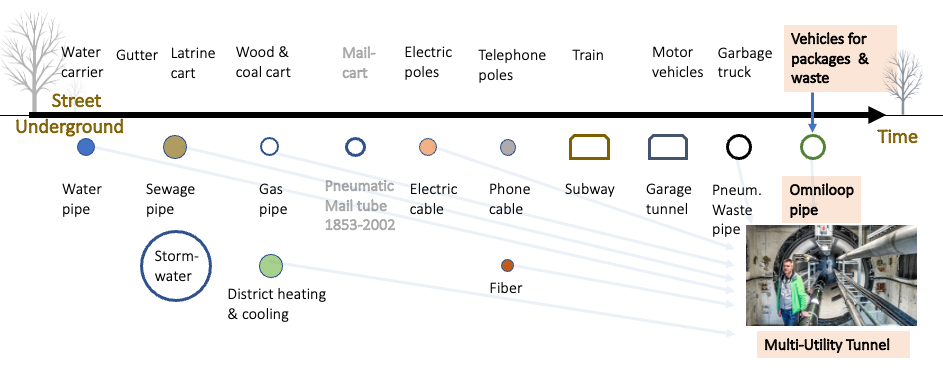
- The Romans built aqueducts and underground canals to transport water instead of using buckets,
- Sewer pipes replaced barrels for human waste, which radically improved health
- Gas pipes and district heating replaced coal carts and oil trucks
- Cables replaced poles for electricity and telecom
- Fibre cables and internet replaced postal vans and mailmen
- Trams were moved to subway tunnels underground to reduce congestion
- Cars use underground parking
- Many cities have built underground motorways
So why does the underground keep winning?
1) Reliability and safety
Underground networks are less exposed to storms, traffic accidents, and day-to-day interference. When something is critical – sanitation, power, communications – cities tend to prefer protected infrastructure.
2) Space is scarce where value is highest
Dense urban land is too valuable to spend on endless surface conflicts: trucks, waste handling, deliveries, service vehicles, and parking. All compete with pedestrians, bikes, green areas, playgrounds, cafés, and public life.
3) Undergrounding reduces conflict between systems
A well-planned sub-surface gives each flow a dedicated space, reducing friction when everything fights for the same street space.
3) Productivity and cost
Most underground systems use much less labor for operations and maintenance than surface systems. However, they require high up-front investments in infrastructure. New tunnelling technologies, such as jacking and horizontal drilling (e.g., the Boring Company), can significantly reduce costs.
4) Multi-Utility Tunnels
By collocating sub-surface flow infrastructure in so-called Multi Utility Tunnels (MUT) or Infra Culverts, installation costs have been reduced further. An additional advantage is that maintenance and upgrading can be performed without digging up the streets. A recent study by Luo et al. (2020) identified 180 MUTs. A dramatic increase in Asia after 2000, with China holding 80% of the MUTs. In Sweden the cities Linköping and Sollentuna have installed MUTs and Malmö is considering it. The different types of pipes and cables in the MUTs are shown below.

Underground urban logistics is the next frontier
Last-mile deliveries, circular flows, and waste transport are increasing the pressure on streets, creating congestion, emissions, noise, and health and safety issues.
In coming posts, we will explain why the proposed introduction of electric vehicles, cargo bikes, parcel lockers, sidewalk robots, and air drones will not be enough. Underground logistics seems to be the only long-term, sustainable solution, as it reduces the need for street space.
That’s why the question is shifting from “If we should move some logistics underground?” to “Which flows should move first, and where does it yield the strongest possible return?”
What would you remove from the street first in your city or district if you had the choice: waste trucks, parcel vans, delivery mopeds, or private cars?
References
Luo, Y., Alaghbandrad, A., Genger, T. K., and Hammad, A. (2020). History and recent development of multi-purpose utility tunnels. Tunnel. Undergr. Space Technol. 103, 103511. doi: 10.1016/j.tust.2020.103511